
Same architecture, different bill
Same architecture, different bill
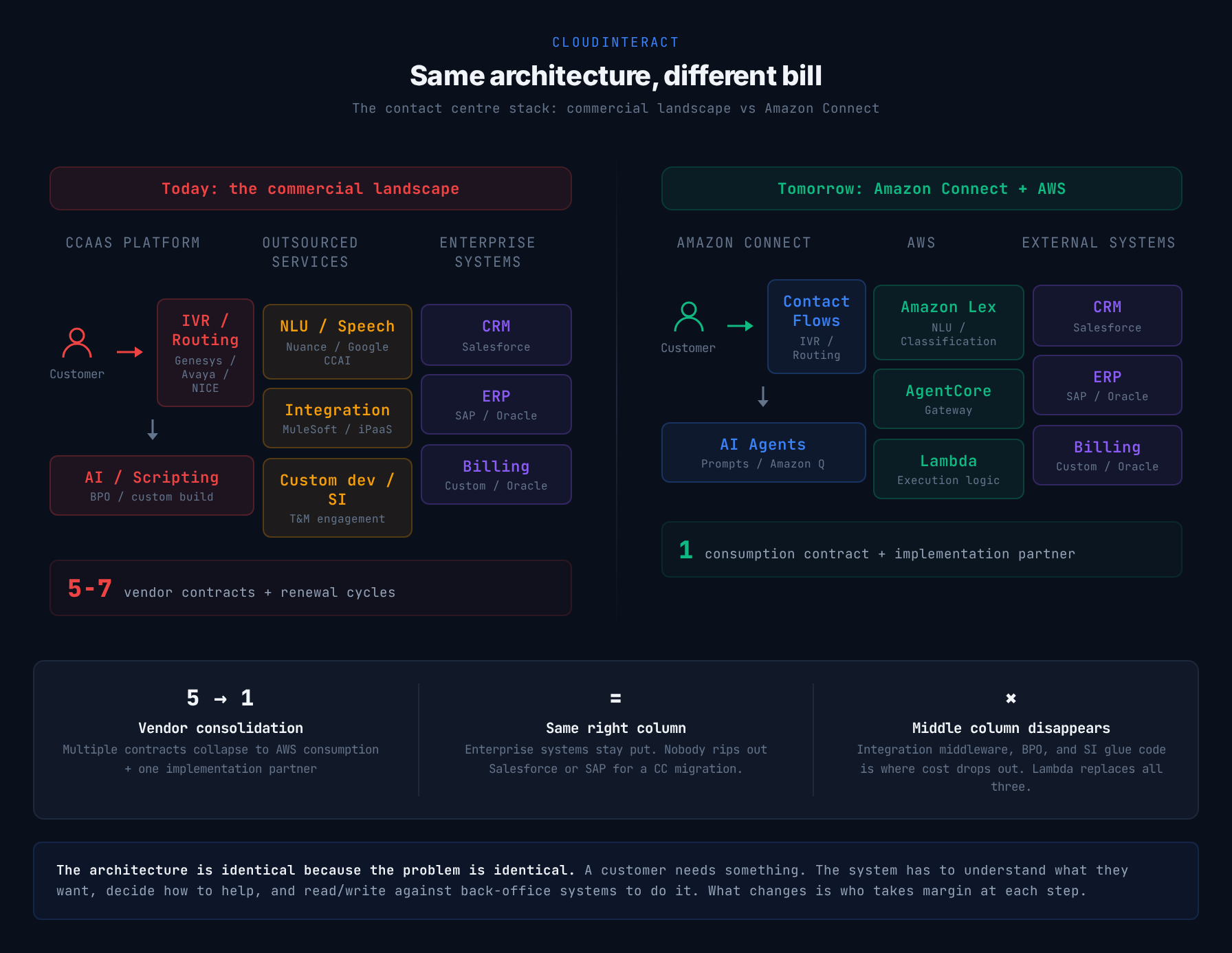
Every contact centre solves the same problem. A customer needs something. The system has to understand what they want, work out how to help, and then read or write against back-office systems to actually do it. That flow is identical whether you're running Genesys, Avaya, NICE, or Amazon Connect.
I drew both versions on a whiteboard last week and the structural similarity was hard to ignore. So I turned them into proper diagrams. The result tells a story that matters commercially.
The architecture is the same
Here's the flow. A customer enters through an IVR or routing layer. That routes to a natural language understanding engine for intent classification. The classified intent feeds into an AI or scripting layer that decides what to do. That orchestration layer pushes through integration middleware and custom logic to read and write against the enterprise systems of record: CRM, ERP, billing.
Six functional layers. Same in every contact centre. Same in 2015, same today, same in 2030.
The structural pattern
Contact centre architecture has six consistent layers: routing, language understanding, orchestration, integration, execution, and systems of record. The vendors change. The pattern doesn't.
The commercial landscape
In most enterprise contact centres today, each of those layers is a separate vendor contract. Genesys or Avaya charges per seat for routing. Nuance or a BPO handles speech and NLU. A systems integrator builds the scripting and glue code on a time-and-materials basis. MuleSoft or another iPaaS platform takes a licence fee for integration. And then Salesforce, SAP, and Oracle sit on the right-hand side collecting their subscription fees regardless.
Count the vendors. Count the contracts. Count the renewal negotiations. That's before you add the internal team managing the relationships between them all.
5-7
Typical vendor contracts
3-5
Integration touchpoints
12-18mo
Average change cycle
The Amazon Connect version
Now look at the same architecture on AWS. The routing layer is Amazon Connect. Intent classification is Amazon Lex. The orchestration layer is Connect's AI Agents and Prompts, with Amazon Q providing the reasoning. AgentCore acts as the gateway, Lambda handles the execution logic. The enterprise systems on the right stay the same because nobody is ripping out Salesforce or SAP for a contact centre migration.
But the left and centre columns have collapsed. Five or six vendor contracts become consumption-priced AWS services plus one implementation partner. The integration middleware disappears because Lambda talks directly to APIs. The systems integrator's T&M engagement becomes a fixed-scope implementation.
Where the cost disappears
The middle column of the architecture — NLU, integration middleware, custom development — is where most contact centre spend accumulates. It's also where Amazon Connect eliminates the most vendor complexity.
Where does value actually sit?
This is the question that matters for anyone evaluating their contact centre stack. The enterprise systems on the right aren't going anywhere. That's sunk cost and it's fine. The platform infrastructure on the left is a commodity either way, whether you pay Genesys per seat or AWS per minute.
The value sits in the orchestration and integration layers. That's where customer outcomes are determined: how accurately intents are classified, how intelligently the AI agent responds, how cleanly the system reads and writes against back-office data. And that's where CloudInteract operates.
We design the contact flows. We engineer the AI prompts. We build the Lambda functions that connect the platform to your systems. We're the layer that turns AWS commodity services into working outcomes.
What this means practically
If you're running a legacy CCaaS platform, you already have this architecture. You're just paying more vendors more money for the same functional result. The migration question isn't whether the architecture changes. It doesn't. The question is whether you want to keep paying the current bill for it.
See the architecture in your context
We'll map your current vendor stack against the Amazon Connect equivalent and show you where cost and complexity drops out.